
The Climate Chronicles attempts to explain how climate change shaped the history of our species. That’s a daunting challenge, for at least three reasons.
First, the story of climate’s past involves countless times and places, not to mention evidence, explanatory models, and concepts from many different disciplines. It’s more than any one person – or even, any group of people – can hope to master. No matter how you tell the story, there will be mistakes: not just basic factual errors but errors of omission, important connections between human and climatic histories (for example) that you didn’t think to include.
To make matters worse, second, the science (and archaeology, geography, or history) of climate keeps changing. Some fields of study change more quickly than others, but all are on the move, and it can be almost impossible for one scholar to keep up. A story that seems true today may not tomorrow – literally – and that can have profound implications for how we understand both the past and the potential future.
Third, it’s hard to tell a story with so many moving parts in a way that anyone can understand. It’s all too easy to assume knowledge, or to explain something poorly because you don’t fully get it yourself. And sometimes, if you don’t properly explain one part of a story, it’s tough for a listener – or a reader – to keep following along.
I’ve written a fair amount about these and other challenges in the telling of climate’s history. I’ve argued that one solution is to be transparent about the uncertainties in the stories we tell, and honest about the mistakes we (inevitably) make in telling them.
Actually, these challenges are why I’ve chosen to create a multimedia project on the history of climate change, rather than write a book (or two). Once books are published, they’re very difficult to change. But I’m able to continually revise The Climate Chronicles, updating episodes to correct mistakes, present new research, or explain concepts more clearly.
On this page, I maintain a list of revisions that I aim to make. At least once per year, I update my episodes using this list. Revisions I’ve made are in grey; revisions I still need to make are in black.
Reading over this list may help you understand just how hard it is to tell a complete story about climate’s past. It may also give you a sense of just how quickly and profoundly scholarship changes. And if you have any suggestions of your own, please feel free to send them my way! I’m always looking to improve The Climate Chronicles.
Episode 16: Megadrought in Mesopotamia
I need to add a bit more complexity to my description of the 4.2ka BP event. I’m a little off on where precipitation went up (not just outside of the tropics, but in specific regions, and of course the Middle East is not all in the tropics). I should also mention scholarship that indicates the drying in some regions occurred in two distinct pulses. See for example:
- Railsback, L. et al., “The timing, two-pulsed nature, and variable climatic expression of the 4.2 ka event: A review and new high-resolution stalagmite data from Namibia.” Quaternary Science Reviews 186 (2018): 78-90.
- Perşoiu, Aurel, Monica Ionita, and Harvey Weiss, “Atmospheric blocking induced by the strengthened Siberian High led to drying in west Asia during the 4.2 ka BP event–a hypothesis.” Climate of the Past 15:2 (2019): 781-793.
In this episode, and perhaps in episode 12, I need to temper some of my suggestions about agriculture and war. For a long time, archaeologists and anthropologists believed that war emerged with agriculture, as I imply. That’s true, according to some definitions of war. But many scholars now believe that organized violence between populations may have been common even in foraging and hunting communities. Most now argue that agriculture intensified this form of violence and changed its character, rather than creating it. See, for example:
- Gat, Azar. War in Human Civilization. Oxford: Oxford University Press, 2006.
Episode 15: The Drying of the Sahara
In dates, I should swap “K,” for “KA.”
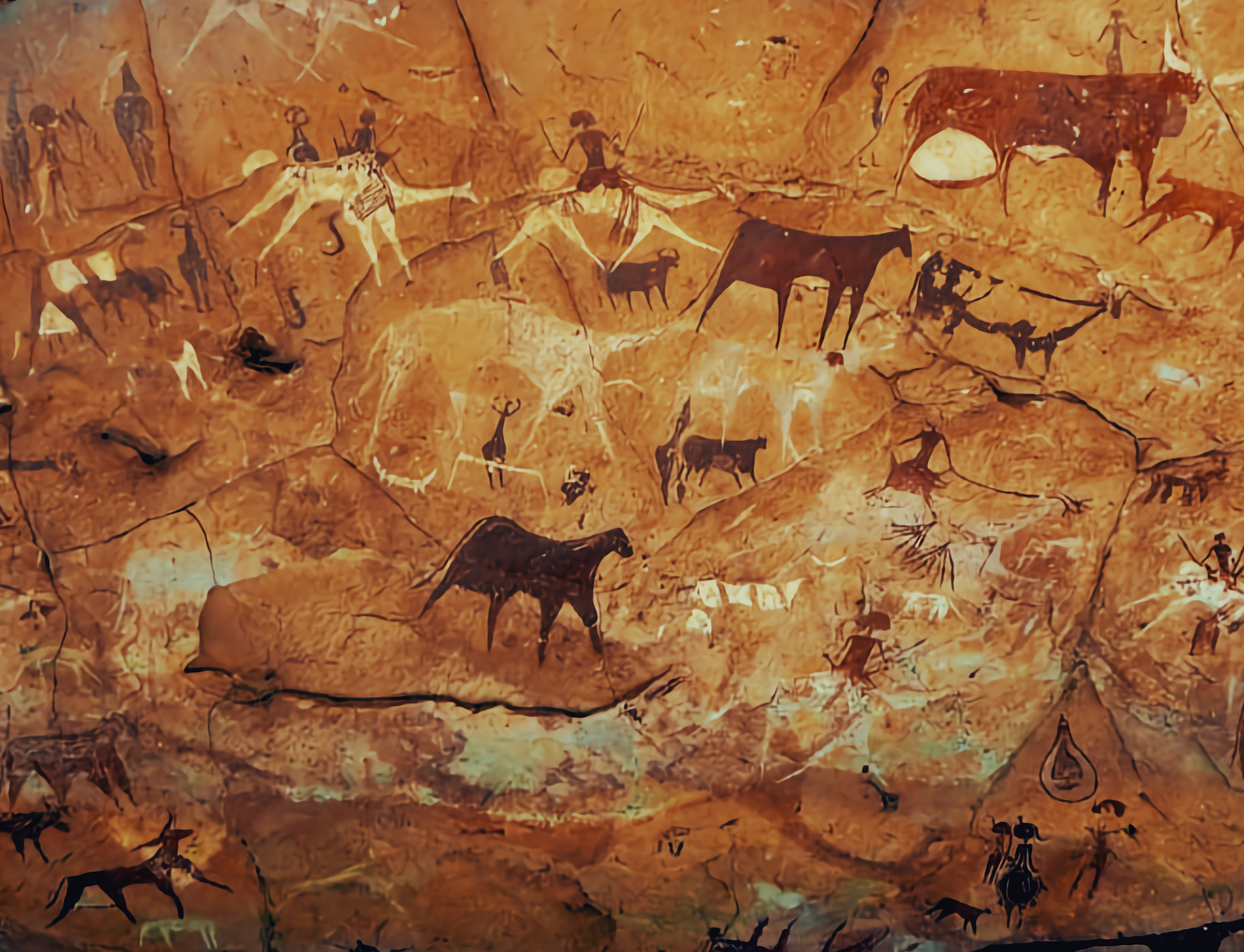
It’s worth noting that some herders in the drying Sahara adapted by, for example, switching from cattle to sheep and goats, which could better handle arid environments.
I need to change the following: “all mingled with local cultures that depended on agriculture, trade, and specialized crafts” to “all mingled with local cultures that depended on fishing, foraging, trade, and specialized crafts.” Overall, my explanation for the emergence of ancient Egypt is a little superficial; it needs sharpening but it has to remain concise, as I’ll return to this theme in a future episode. My revised explanation should draw on, for example:
- Guyot, Frederic, “The Nile Delta Before the Pharaohs,” in The Nile Delta: Histories from Antiquity to the Modern Period (2024): 105.
Episode 14: The Hottest Holocene
I assumed that the term “Postglacial Hypsithermal Interval” didn’t stick. I need to verify that indeed it had limited influence.
I also mention that radiocarbon dating allows scholars to precisely date things. That’s not quite right, as there are meaningful dating uncertainties that increase the older something is.
Episode 13: The Bones at Star Carr
In dates, I should swap “K,” for “KA.”
Episode 12: The Natufian Wager
I should specify that it was summer monsoons that grew weaker across Asia and Africa during the Younger Dryas.
I claim that a “layer is about 80,000 years old, which places it in the warmer, wetter Eemian interglacial.” This isn’t true – 80,000 years ago is actually in the Last Glacial Period.
I mention that agriculture yielded less nutrition. That was true per capita, but not in aggregate for human populations.
I need to temper some of my claims about the significance of redating pollen. What was crucial was that re-dated pollen showed that full-blown agriculture matured long after the Younger Dryas, and that the transition to agriculture was a gradual process.
Episode 11: Memories of Atlantis
There’s new scholarship that indicates that the woods of Doggerland were remarkably lush, even not long after the nadir of the Last Glacial Maximum. See, for example:
- Allaby, Robin G. et al. “Early colonization before inundation consistent with northern glacial refugia in Southern Doggerland revealed by sedimentary ancient DNA.” PNAS 123:11 (2026): e2508402123.
Episode 10: The Younger Dryas Diaries
While scientists once believed that the Atlantic Meridional Overturning Circulation (AMOC) broke down entirely during the Younger Dryas – as I claim in this episode – more and more evidence now suggests that it weakened without shutting down. In fact, some evidence is beginning to emerge that parts of the AMOC, at least, may have actually strengthened during the Younger Dryas. Scientists now understand that the AMOC is an incredibly complex and heterogeneous system; it does not simply switch on or off.
New simulations that include more accurate values for meltwater from the Greenland Ice Sheet also suggest that the AMOC may be more resilient in the face of present-day warming than earlier simulations indicated. Part of the reason is that deep water formation could migrate north. An AMOC shutdown increasingly seems like an unlikely prospect, though weakening is likely, and weakening could still alter temperature and precipitation patterns on continental scales.
I should also update this episode with new scholarship that may suggest – after all – a volcanic origin for the Younger Dryas. See:
- Nana Yobo, Lucien et al. “Volcanic forcing of global climate cooling at the Younger Dryas onset preserved in North American sediments.” Science Advances 12:18 (2026): eaec9030.
Also, emerging evidence indicates that there may have been a two-part weakening of the AMOC during the Younger Dryas, not just one. See:
- You, Defang et al. “Surface freshening in the subpolar North Atlantic sustaining the weakened AMOC during the late Younger Dryas.” Science Advances 12:1 (2026): eadv6220.
I claim that anthropogenic climate change might be older than writing or agriculture. But in a later episode, I provide cutting-edge evidence – derived from machine learning – which indicates that writing may be much older than the Younger Dryas, let alone agriculture.
I mention that the megafauna extinctions may have reduced atmospheric concentrations of methane. But according to my colleague Erle Ellis, reductions in grazing megafauna also allowed woodland to replace grassland and shrubland. This would have fixed more carbon dioxide in the biosphere and released less into the atmosphere, further amplifying the cooling.
I should point out that, along the southern North Sea basin, the population density of Ahrensburgian hunting and gathering communities declined with the onset of the Younger Dryas. Cooling may have been partly responsible, along with an increase in the frequency and severity of wildfires in a drier climate. The human story of the Younger Dryas was not just one of resilience and adaptation.
There’s also fascinating new genetic evidence that I can now add to this episode.
Episode 9: The Last of Them
There’s some very exciting new scholarship to add to this episode. First, it seems Neanderthals and sapiens worked together in the Levant – for thousands of years. See:
- Zaidner, Yossi et al. “Evidence from Tinshemet Cave in Israel suggests behavioural uniformity across Homo groups in the Levantine mid-Middle Palaeolithic circa 130,000–80,000 years ago.” Nature Human Behaviour 9:5 (2025): 886
Second, some Neanderthals appear to have preyed on anyone who wasn’t in their social group. See:
- Cosnefroy, Quentin et al. “Highly selective cannibalism in the Late Pleistocene of Northern Europe reveals Neandertals were targeted prey.” Scientific Reports 15:1 (2025).
There’s more evidence for one explanation for the Neanderthal disappearance: the stronger social connections forged by Homo sapiens. See:
- Burke, Ariane et al. “Spatial resilience and population replacement in Europe during MIS 3: a comparative study of Neanderthals and H. sapiens.” Quaternary Science Reviews 2026, 377.
Episode 4: The Precarious Pleistocene
I claim that killer whales could cope with cold water more effectively than the megalodon. That’s probably true, but it’s worth noting that the megalodon was warm-blooded.
The nuclear reactor at Camp Century was not the world’s first mobile reactor; it was one of the first.
I briefly mention the Mid-Pleistocene Transition (MPT) and provide some tentative explanations for it. But the MPT is a much bigger deal than I currently suggest. Its causes remain mysterious, with different groups of scholars offering distinct explanations. I should devote a bit more space to the MPT.
Episode 3: The Great Cooling
As in many big histories, I currently accept the theory that expanding African savannah landscapes encouraged the evolution of bipedalism (often called the “savannah hypothesis” or “savannah-based theory”). This theory was widely accepted for much of the twentieth century by many paleoanthropologists, evolutionary biologists, and physical anthropologists. It was especially influential from roughly the 1920s through the 1980s.
Over the past few decades, however, researchers have criticized or revised the savannah hypothesis. They’ve found that early hominins often lived in mixed woodland environments rather than pure savannah; that some of the earliest bipedal hominins appear associated with wooded habitats; and that environmental variability now seems more important than a simple forest-to-savannah transition. There does still seem to be a connection between cooling and drying trends, increased environmental diversity, and bipedalism, and I need to revise this episode with that in mind. See, for example:
- Senut, Brigitte, Martin Pickford, Dominique Gommery, and Loïc Ségalen, “Palaeoenvironments and the origin of hominid bipedalism.” Historical Biology 30:1-2 (2018): 284-296.
It’s also an oversimplification to say – as I do right now – that in the face of long-term cooling trends, “many plants accelerated their growth cycles, allowing them to reproduce in short summers, while others evolved the ability to remain dormant for long stretches of wintry weather.”