
Listen to the Episode:
On the southern edge of the Kalahari Desert in South Africa’s vast and sparsely populated Northern Cape province, there is a large opening in the sedimentary rock of the Kuruman Hills.
About two million years ago, a member of a hominin species named Homo erectus, meaning “upright man,” first walked through that opening.
Homo erectus was maybe the first hominin species that looked and acted, well, human. Actually, it can be hard to see a recreation of a Homo erectus and not experience the “uncanny valley effect”: a reaction to things that look human without quite being human.
The average Homo erectus had a brain about two and a half times bigger than that of a chimpanzee, or about three-quarters the size of our brain.
Individuals stood between 4’9” and 6’1”, and they weighed between 88 and 150 pounds. They were slender, with proportions not unlike those of many modern humans, and they walked a lot like we do.
Homo erectus communities also did things that seem decidedly human.
They forged symmetrical hand axes and cleavers, tools more useful and more difficult to create than anything hominins had made before.
They lived in groups, and appear to have cared for their elderly and injured.
And about a million years after they first entered that opening in the Kuruman Hills, one group of Homo erectus seems to have taken one of the great leaps in hominin history.
A leap that would allow our ancestors to cope with climate change as they never had before.
It’s why the opening is now called Wonderwerk Cave, meaning: the cave of miracles.
Welcome to the fourth episode of our first season, “Becoming Human.”
In this episode, I’ll tell you about the miracle that unfolded in Wonderwerk Cave.
I’ll explain how it was one among a series of breakthroughs that helped protect our hominin ancestors from the dangerous consequences of climate change.
We’ll think through what it means to be resilient in the face of climatic cooling – or warming.
And then we’ll see how climate change might have helped Homo erectus embark on what was, to that point, the greatest adventure in hominin history.

Archaeologists first established that a Homo erectus community occupied Wonderwerk Cave by identifying bones and hand axes in cave sediments.
When those archaeologists examined the sediments through a microscope, they also found ashes and burned bits of bone.
Now, burned material has a different molecular structure depending on how hot it got. It’s possible to identify its molecular structure – and so determine how hot it got when it was burning – by measuring how it absorbs infrared light.
Using this technique, which is called infrared spectroscopy, archaeologists concluded that the burnt residue in Wonderwerk Cave had been heated to between 400 and 500 degrees Celsius: ideal for cooking.
The preservation of the ash, and the jagged edges of the bone pieces, indicated that the burned material hadn’t been brought into the cave by water or wind. And lightning couldn’t have reached the interior of the cave.
Of course, the fires revealed by the cave sediments could have been kindled thousands of years after the Homo erectus community lived there.
To find out, researchers turned to one of the ways that the Earth keeps time.
Our planet’s atmosphere is continually pelted by cosmic rays: energetic particles released by the Sun, or distant cosmic phenomena, such as exploding stars.
When these particles smash into Earth’s atmosphere, they create secondary particles, which then go on to make isotopes in the air and on the surface. Remember, isotopes are atoms of the same element whose nuclei contain different quantities of neutrons.
Isotopes are continually produced by the bombardment of cosmic rays. Yet because many are radioactive, they also continually decay. They’re radioactive owing to an imbalance between the number of neutrons and protons in their atomic nuclei.
Anyway, to simplify things considerably, the constant rate at which isotopes are produced by cosmic rays and destroyed by radiation allows researchers to use their concentrations in things to estimate the age of those things.
Think of it this way. You have a bank account you never touch. Every month, it receives an automatic deposit of, say, $200. And every month there’s an automated withdrawal of $100. Imagine you forget about that bank account. You don’t even remember opening it. Then, one day, to your horror – you do remember. You open the account. The total amount of money in the account will let you estimate its age – right?
Anyway, the quantity of these cosmic isotopes in the burned residue at Wonderwerk Cave allowed researchers to estimate when Homo erectus individuals first arrived in the cave, when the fires were first kindled there, and when the Homo erectus community disappeared.
It turned out that a Homo erectus group made a home in Wonderwerk Cave about two million years ago. And a community was still there one million years ago, when the fires appeared.
Clearly, they had learned how to control fire.

Much of our knowledge of the distant past for humans and their ancestors comes from archaeological detective work of this sort, and I’m often impressed by its creativity. But it’s worth considering just how many questions it can’t answer.
Archaeologists don’t know, for example, whether the people – and I think we can call them people – of Wonderwerk Cave could merely harness fire, or create it.
Even some communities of our species, Homo sapiens, never figured out how to kindle fire. So, it’s possible that the Homo erectus community in Wonderwerk Cave only knew how to keep a fire going that had been started by lightning.
Nor do we know whether the people of Wonderwerk Cave were the first hominins to ever use fire.
Archaeologists have uncovered heated sediments at a site in Kenya, and burnt bones at another cave in South Africa, that both seem to be about one and a half million years old. Both places were occupied by Homo erectus communities.
But it’s unclear whether the fires that happened in these locations were used by those communities. They may have started for natural causes, and then burned themselves out with no intervention by the local Homo erectus population.
The trouble with archaeological evidence is that it simply can’t answer some of our biggest questions about the deep past.
Archaeologists work with the tiny fraction of hominin bodies and artifacts that have survived to the present, all of which come from sites that are dry enough to permit their preservation.
It’s incredibly difficult to use this very limited evidence to figure out exactly when important things happened for the first time, or especially how they happened, let alone why they happened.
Take fire. Why did the community at Wonderwerk Cave first decide to use it? Were they copying another, unknown group of hominins?
Did some Homo erectus genius observe that animals were afraid of natural fires? Did that unusual member of the species decide to harness fire to scare away predators at night – such as big cats that can see better than hominins in the dark?
Or did she simply decide that fire was warm, and warmth was useful? Or that it would be helpful to have some light after the Sun went down?
Maybe she happened across a dead animal that had been roasted in a brushfire sparked by lightning. She liked the taste, and soon everyone was cooking their food.
After all, cooking makes meat easier to digest and slower to spoil. It kills some bacteria and neutralizes some toxins, making meat safer to eat.
All we can do is speculate about the motivations of the first hominin fire-users. And all we can do is lament the limitations of the archaeological record.
We do know that fire use spread relatively quickly among hominin groups, until it became universal. Every Homo sapien community ever studied by archaeologists and historians made some use of fire.
Stephen Pyne, the world’s leading historian of fire, argues that a new era in Earth’s history had begun. As a fire historian, he views the changing behavior of fire as shaping our planet’s deep past.
For him, Earth’s first era started with the formation of the planet and lasted until about 2.35 billion years ago. In this era there was no fire, because there was no oxygen in the atmosphere to enable combustion. Then, in the second era, from 2.35 billion years ago to 400 million years ago, the introduction of oxygen into the atmosphere permitted fire, but there was little to burn. In the third era, beginning 400 million years ago, the spread of plants on land provided plenty of fuel for fires.
The Earth was now unique in the solar system. It had become a planet that burned.
By a million years ago, Homo erectus had sparked the fourth era. An animal had for the first time become a “fire broker,” an agent capable of introducing fire to new lands and landscapes.
Pyne imagines the control of fire as the first domestication in hominin history. He sees it as the beginning of what he calls a “mutual assistance pact.” That’s because fire and hominins could together spread across more of the world than they would have reached by themselves.
Every hominin with the necessary intellectual horsepower adopted fire because it was useful. It gave our ancestors advantages that no other species could match.
Now, we could outgun the toughest predators, work and play at night, and squeeze more nutrients from food to fuel ever bigger and better brains.
But equally important was that our ancestors had found a way to buffer themselves from the influence of climate.

Fire provides heat, which is helpful not only in climates at high latitudes or altitudes, but also in dry climates, where the lack of moisture in the atmosphere can cause temperatures to fall quickly at nighttime.
Of course, conditions across most of the Earth were much chillier and drier during glacial periods than they are now. Winters were far longer.
The warmth of fire would have been that much more valuable.
Fire also helped hominins live at high latitudes because it provides light, and of course winters are darker for longer the further north (or south) you get.
Even more importantly, fire allowed hominins to shelter in caves, such as Wonderwerk, which otherwise would have been too dark, too cold, or too damp to use.
Fire also enabled hominins to eat more diverse plants and animals, because it removed toxins and released nutrients.
Now, when climates change, so do ecosystems. With fire, hominins could more easily migrate away from altered ecosystems, or eat new plant and animal species that arrived when those ecosystems got colder and drier, or warmer and wetter.
What’s more, fire helped hominins chase predators away from meat, including cats and canids that might otherwise have been far too dangerous to challenge.
In times of scarcity – during droughts, for example – this new power doubtless helped hominin communities survive.
But the most important benefit of harnessing fire might have been the least tangible, and in some ways the hardest to discern in archaeological evidence.
You see, it took teamwork to keep a fire going, and to realize all of its potential applications. Fire strengthened the feedbacks we’ve already discussed – the ones that continued to enhance hominid social cooperation and intelligence.
These were exactly the qualities that permitted the use of new tools, such as fire, which insulated, or buffered, communities from the destructive effects of climate change.
This “buffering” is one dimension of what climate researchers often call resilience.
Now, the term “resilience” is actually quite hard to define, and since it’s extremely important in climate discussions I think we should take a few minutes to break it down.
In the 1960s and 1970s, ecologists began to use the term to study how ecosystems could handle disturbances while keeping their essential characteristics and functions.
Scholars in climate-related fields, such as disaster risk management, quickly adopted the word. At first, they defined resilience as the ability of a population to return to its former state in the wake of a disaster.
Academics love to criticize one another for using words in the wrong way, and that’s exactly what happened now.
Some argued that by using resilience to mean “bouncing back” from disaster, scholars had wrongly associated social change with failure. Stability, after all, isn’t worth much when a stable social order is deeply unjust.
Later, other critics pointed out that focusing on resilience can make climate disasters seem natural and inevitable, when they might really be human caused. They might be the outcome of greenhouse gas emissions released by big businesses that aren’t properly regulated by governments, for example.
Some argued that using the word made those disasters seem like the fault of local communities that hadn’t sufficiently prepared themselves, rather than – again – those governments and corporations.
We’re just scratching the surface. In climate research, words like “resilience” can be controversial partly because they seem to have political significance.
Beginning in the 1980s, oil company advertisements, for example, emphasized how American settlers had always moved to new climates. The point: Americans were resilient to climate change, so regulating carbon emissions wasn’t necessary.
As you can imagine, all of this advertising didn’t exactly endear the word “resilience” to climate researchers.
But by harnessing fire, Homo erectus communities had clearly developed greater resilience to climate change – if we define that word broadly.
The Intergovernmental Panel on Climate Change, or IPCC, the United Nations body that assess the science of climate change, uses a definition that I like.
It defines resilience as the capacity for human and natural systems “to cope with a hazardous event or trend or disturbance, responding or reorganizing in ways that maintain their essential function, identity and structure.”
So, let’s say a community experiences a drought that can be blamed on climate change. We might say it’s been resilient if it stays the way it was before the drought. Or we can say it’s resilient if it changes to cope with the drought, without losing its basic characteristics.
Seems pretty straightforward, right?
Well, the definition isn’t quite as clear as it may appear. Just think: exactly how much does a community have to change before we decide that it’s no longer resilient?
As I say these words, parts of Los Angeles are burning down. The scenes on television and social media are apocalyptic. Thousands of structures have been destroyed. But the city will survive, few people are likely to die, and in the long run the city’s culture probably won’t change much.
Does that really mean the city has been resilient?
You see, in climate research, even definitions that seem perfectly objective and comprehensive – and the IPCC’s definition of resilience is one of them – actually turn out to be quite messy.
In any case, if we define resilience broadly and acknowledge that it’s hard to pin down, then we can easily find compelling evidence that Homo erectus was more resilient to climate change than any hominin that had yet evolved.
The most compelling evidence? Homo erectus seems to have been the first hominin species to migrate out of Africa.
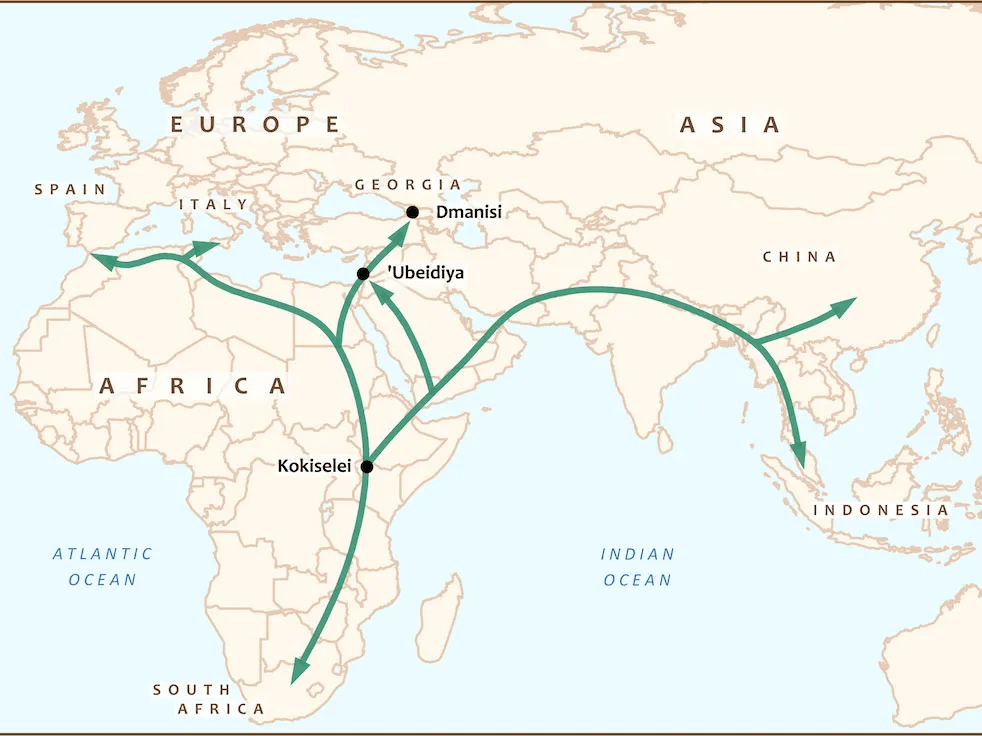
The migration of Homo erectus communities out of Africa was, to that point, possibly the greatest achievement in the history of our family of animals.
It was truly an unprecedented step into the unknown.
Fossils suggest that the species had evolved in East Africa about two million years ago. Brand new research, published as I recorded this episode, dates bones in Romania, clearly marked by Homo erectus, to 1.95 million years ago! Remarkably, some members of the species seem to have left Africa right after they evolved.
Other fossils recovered in Dmanisi, an archeological site in the country of Georgia between the Black and Caspian Seas, show that other Homo erectus communities had spread beyond Romania by 1.8 million years ago.
They appear to have colonized a familiar, savannah ecosystem during a relatively warm period between the 41,000-year cold phases of the early Pleistocene.
Fossils dated to a few hundred thousand years later reveal that some Homo erectus communities kept moving. Not long after the species settled in Georgia, it arrived in East and Southeast Asia.
It’s possible that other communities eventually found their way into southwestern Europe, though the fossil evidence appears ambiguous.
Even in savannah environments, climates varied from place to place. New tools, new forms of social cooperation, and an alliance with fire seem to have given Homo erectus a capacity that earlier hominins had not had: a capacity to be resilient in the face of new climates. It seems to have a prerequisite for migration.
But for Homo erectus, resilience involved more than coping with differences in climate. It also involved exploiting the opportunities created by Pleistocene climate changes.
The spread of the species across the world actually owed a lot to those Milankovitch cycles in Earth’s rotation and orbit that we discussed in our last episode, and the climatic changes they seem to have set in motion.
You’ll remember that the potential origins of fire use among Homo erectus were all in southern or eastern Africa.
In these regions, savannah landscapes replaced tropical forests in the early Pleistocene. Cooling reduced the range of those forests, drying made them more reliant on seasonal rains, and the increased seasonality of rains simply did not square with the water demands of the forests, which required consistent rainfall.
More seasonality simply means that there’s a greater distinction between seasons – in this part of the world, between rainy and dry seasons. The rainy season might get wetter, the drier season might get drier – or both.
Why did the seasonality of rainfall increase? Partly because, in a colder world, there was a greater difference between temperatures in the tropics, which were still pretty high, and the poles, which were cooling. In response, atmospheric circulation, or the movement of air across Earth’s surface, intensified.
Stronger circulation seems to have whisked more moisture from subtropical regions and increased the variability of a belt of rains around Earth’s equator. This belt is known as the intertropical convergence zone, or ITCZ. It’ll pop up again in future episodes, so I won’t describe it in detail now.
The upshot is that, about two million years ago, savannah landscapes were spreading across Africa just as hominins acquired mutations that made them better adapted to those landscapes. Of course, these mutations gradually gave rise to Homo erectus.
Now, once established, savannah landscapes in South and East Africa did not change as much as other environments during the climatic swings of the Pleistocene.
That’s because savannah landscapes are resilient to climatic variability. Their grasses, shrubs, and trees are drought- and fire-resistant. They bounce back quickly from extreme weather that would devastate forests.
Savannah ecosystems in Africa were therefore refugia, or safe havens, in the Pleistocene world. They were environmentally stable regions that hominins could spread out of, or return back to, when a changing climate altered other environments.
Refugia formed a kind of home base for Homo erectus populations.
Remember, climatic changes during the early Pleistocene were, broadly speaking, paced by cycles in obliquity, or how tilted Earth was on its axis. Earth went through 41,000-year cycles in how much it leaned on its axis.
But when it comes to climate change, things are always, always more complex than they seem at first glance.
Even though ice sheets responded most dramatically to changes in obliquity during the early Pleistocene, cycles in precession (that’s where Earth’s axis points in space) and eccentricity (meaning the ellipticity of its orbit around the Sun) strongly influenced the climate of the tropics and subtropics.
Every 21,000 years, these cycles aligned so that summer in the northern hemisphere coincided with the part of Earth’s orbit that brought the planet closest to the Sun. Strong summer heating meant that more water evaporated from the oceans and flowed as moist air into the interior of continents.
These flows were part of monsoons: seasonal wind systems created by temperature differences between land and ocean. Even today, monsoons are what bring alternating wet and dry periods to many tropical and subtropical regions across the Earth.
Fossilized lakebeds, pollen deposits, and computer models simulating Earth’s climate: all tell us the same story. In the early Pleistocene, the strengthening of monsoons every 21,000 years temporarily created watery grasslands across today’s Saharan and Arabian deserts.
About 1.8 million years ago, Homo erectus communities could hunt across these landscapes, travelling further and further north and east until they’d left Africa.
By about one and a half million years ago, forests had given way to open grassland across central and southeast Asia. Giant herbivores roamed across this landscape, such as the Stegodon, an elephant species with huge straight tusks that stood up to 13 feet tall at the shoulder, and the bizarre ancestors of the wooly rhinoceros, animals with horns over three feet in length.

Homo erectus groups had the teamwork and tools to hunt even these powerful beasts across Eurasia.
So, climate changes operating on different timescales had, first, created a safe environment for Homo erectus in Africa, second, expanded that environment across Eurasia, and third, formed temporary corridors that helped Homo erectus communities reach that expanded environment from Africa.
Still, even if climate change paved the way out of Africa, it wasn’t exactly easy for Homo erectus groups to migrate. Wandering north and west, out of familiar hunting grounds, came with risk. Seasons worked a bit differently out of Africa. Plants and animals went through life cycles that weren’t quite the same.
It took a resilient species to migrate out of Africa, one that could both resist and adapt to environmental change. There’s a reason that no hominin before Homo erectus was able to do it.
And after Homo erectus populations spread across Eurasia, they found new, diverse environments on the fringes of grasslands: rainforests, for example, or wetlands, and along the coast.
These environments really were radically different from the savannah. Their climates were unfamiliar. They had ecosystems with animals that no hominin had never hunted before, and plants with roots and fruits they had never gathered before.
Homo erectus communities were adaptable enough to colonize many of these environments.
Yes, hominin bodies had evolved for the savannah. But hominin minds had become general-purpose computers that enabled Homo erectus to exploit many different ecosystems. Armed with new capacities for communication and social organization, with simple but effective tools and weapons, and with fire, a hominin species for the first time spread across much of the Earth.

Homo erectus walked across this planet for about two million years. It was, by far, the hominin species that survived for the longest time.
Artifacts and bones dated by archaeologists suggest that Wonderwerk Cave was used by Homo erectus communities for an almost unfathomable amount of time: some one and a half million years.
Consider that one of our oldest permanently inhabited settlements, the Palestinian city of Jericho, has been occupied for only about 12,000 years!
There were probably never more than a few hundred thousand Homo erectus individuals alive at any one time. It’s remarkable that the species endured for so long in an epoch when the Earth changed so much.
But there were changes coming that even Homo erectus could not cope with. Changes that would transform the Earth – possibly forever.
For Teachers and Students
Review Questions:
- What was Homo erectus?
- What are isotopes, and how can they tell us about human and environmental history (you may also want to review episode 2)?
- What is climate change resilience, exactly?
- How did Homo erectus develop and demonstrate resilience in the face of climate change?
Key Publications:
Berna, Francesco, Paul Goldberg, Liora Kolska Horwitz, James Brink, Sharon Holt, Marion Bamford, and Michael Chazan. “Microstratigraphic evidence of in situ fire in the Acheulean strata of Wonderwerk Cave, Northern Cape province, South Africa.” Proceedings of the National Academy of Sciences 109:20 (2012): E1215-E1220.
Curran, Sabrina C., Virgil Drăgușin, Briana Pobiner, Michael Pante, John Hellstrom, Jon Woodhead, Roman Croitor et al. “Hominin presence in Eurasia by at least 1.95 million years ago.” Nature Communications 16:1 (2025): 836.
Pyne, Stephen J. The Pyrocene: How we created an age of fire, and what happens next. Univ of California Press, 2022.
Timmermann, Axel, Kyung-Sook Yun, Pasquale Raia, Jiaoyang Ruan, Alessandro Mondanaro, Elke Zeller, Christoph Zollikofer et al. “Climate effects on archaic human habitats and species successions.” Nature 604, no. 7906 (2022): 495-501.
Video and Audio Credits:
José-Manuel Benito Álvarez (España), “Cordate shaped hand axe (replica).” Available at: https://en.wikipedia.org/wiki/Homo_erectus#/media/File:Bifaz_cordiforme.jpg.
“Reconstruction of Turkana boy with light clothing by Adrie and Alfons Kennis at the Neanderthal Museum.” Available at: https://en.wikipedia.org/wiki/Homo_erectus#/media/File:Homo-erectus_Turkana-Boy_(Ausschnitt)_Fundort_Nariokotome,_Kenia,_Rekonstruktion_im_Neanderthal_Museum.jpg
Tim Evanson, “Reconstruction of a female H. erectus.” Reconstruction by John Gurche. Available at: https://en.wikipedia.org/wiki/Homo_erectus#/media/File:Homo.erectus.adult.female.smithsonian.timevanson.flickr.jpg.
“Wonderwerk Cave.” Zamani Project. Available at: https://www.zamaniproject.org/site-south-africa-wonderwerk-cave.html
Werner Ustorf, “Homo erectus reconstruction, Natural History Museum, London.” Available at: https://en.wikipedia.org/wiki/Homo_erectus#/media/File:Homo_erectus_reconstruction,_Natural_History_Museum,_London.jpg
Audio Tools: AIVA, Runway.
Video Tools: Runway, Sora.
Funding provided by Georgetown University’s Earth Commons.
Leave a Reply