Listen to the Episode:
The Earth has been many planets.
It has been a world without fire, and a world without ice.
It has had an atmosphere too toxic to breathe. It has been enveloped by dust too thick to let in sunlight.
It has been a barren wasteland, and a world brimming with life. It has had one continent, then many.
Its oceans have risen and fallen, its animal kingdoms have flowered and withered.
And all the while, it kept note. It recorded its own changes, like you might keep a diary.
And in this archive, there may be hints that we are not the first to force our planet to become something new.
Welcome to the first episode of our first season, “Becoming Human.”
Each of our seasons will be five episodes long. In this first season, we’ll explore how and why climate changed in the deep past, hundreds of thousands and millions of years ago.
We’ll explore how climate change influenced the evolution of humanity and its ancestors. We’ll find out how those ancestors learned to cope with climate change. And we’ll see how scientists discovered, and are continuing to discover, this extraordinary history.
In this episode, I’ll tell you how scientists use atoms, the building blocks of nature, to read Earth’s archive.
I’ll show you how scientists identify planetary transformations in deep time. I’ll give you a sense of the magnitude of the changes Earth is undergoing today, most importantly its changes in climate, and I’ll begin to explain how they’re happening.
Then we’ll use the history recorded by our planet to ask one of my favorite questions. A question that might seem ridiculous, straight out of science fiction. But a question that turns out to be harder to answer than you might imagine.
Are we really the first intelligent creatures to remake our planet into a different sort of world, with a different, less habitable climate?

You can think of the Earth as a giant puzzle that has been rearranged many times in its four and a half billion-year history. Whenever its pieces are scrambled and reassembled, a permanent record is preserved in what folks like me call the archives of nature.
These archives are those parts of the natural world that develop gradually. Think of stalagmites in a cave. They’re like upside-down rock icicles. They grow with every mineral-filled drop from a cave ceiling.
Drop by drop, decade by decade, century by century, they rise from the cave floor.
Now, natural archives such as speleothems – another word for cave formations – grow in different ways, or at different rates, when the world works differently. These new ways of growing can be preserved in the makeup of natural archives, in the mineral layers of a stalagmite, for example.
And because layers in natural archives add up at a predictable rate, scientists can study the composition of speleothems, for example, to figure out how the world’s puzzle pieces were once assembled – or disassembled.
Believe it or not, your teeth are archives of nature.
Teeth are lined with enamel and dentin, tissues that are full of the elements oxygen and strontium. Atoms of these elements come in different varieties, or isotopes, based on how many neutrons are in their nuclei. A neutron is a tiny particle that doesn’t have an electric charge.
Isotopes are hugely important in climate research. That’s because the ratio in natural archives of isotopes with more neutrons, which we call heavy isotopes, versus isotopes with fewer neutrons, which we call light isotopes, can give scientists some of their best clues as to how environments changed in the past.
For example, the water you drink affects the mix of oxygen isotopes in your tooth layers. The reason is that the isotopes in water can be, on average, heavier or lighter, depending on the climate in which you live.
The food you eat alters the mix of strontium isotopes in your teeth. Plants, and through them animals, absorb strontium from the soil. Different plants, grown in different soils, will have a distinct mix of strontium isotopes. And when you eat them, those isotopes enter your teeth.
So, your teeth record the world in which you live.
If alien scientists arrive at Earth in a thousand years and they come across your skeleton, they could use your teeth to figure out that Earth’s climate was warming in our time, and that humans had learned to grow and ship food all over the world.
Your teeth are one way that Earth remembers these changes.
Now, the layers in your teeth don’t directly measure environmental changes, like a thermometer would, for example. Isotopes are messier than that. The oxygen isotope mix in your teeth is influenced not only by climate but also by your metabolism, among other things.
So it wouldn’t be easy for alien scientists to isolate the influence of climate change on the isotopes in your teeth.
The environmental information in natural archives actually comes to us through proxies. A “proxy” is something that scientists can use to infer, rather than directly measure, conditions in the past.
Let’s break it down. The archive is your teeth, the enamel and dentin layers in your teeth are the proxies, and the information they can provide is imperfect. But depending on what your alien examiners want to know about Earth’s past, it may be the best thing they have to work with.
Today’s human geologists use archives of nature to figure out approximately when and why Earth’s puzzle pieces snapped together in new ways thousands, millions, even billions of years ago.
They make sense of Earth’s history by identifying these rearrangements and ranking how important they were.
If a lot of puzzle pieces were reassembled in a durable way, geologists say that an eon has passed. They believe that there have only been four eons in Earth’s history. The latest, the Phanerozoic, began 451 million years ago. It’s distinguished by an explosion in the diversity and complexity of life.
For geologists, smaller but still very substantial and long-lasting rearrangements gave rise to new eras. The Earth has experienced ten of these. Our current era, the Cenozoic, began with the extinction of the dinosaurs and is distinguished by the rise of mammals, birds, and flowering plants – by the creation, in other words, of today’s ecosystems.
Still smaller but meaningful rearrangements triggered new periods in Earth’s geological history. There are nearly as many periods as eons – 12, versus 10 – because periods only divide relatively recent eons in Earth’s history.
That’s because complex life didn’t exist in earlier eons, meaning that a powerful engine of environmental change wasn’t around to trigger a new period.
Evidence for environmental change is also less precise, or what scientists call lower resolution, when it’s older. Resolution deteriorates because natural archives degrade over time.
The substantial but comparatively subtle changes that triggered new periods, as opposed to eons and eras, are harder to identify the further back in time we look.
In any case, our current period, the Quaternary, is distinguished by the coming and going of glacials, or what are commonly called ice ages.
Even smaller reshufflings of the Earth puzzle are called epochs. Our species, Homo sapiens, has either been through two or three of these.
We evolved in the Pleistocene, when glacials came and went. The Pleistocene began at the same time as the Quaternary, about two and a half million years ago. We learned how to grow food, domesticate animals, write, and build cities in another epoch, the Holocene, which is really interlude between glacials that began about 11,700 years ago.
And some geologists have argued that, about 70 years ago, Earth entered a new epoch: the Anthropocene.
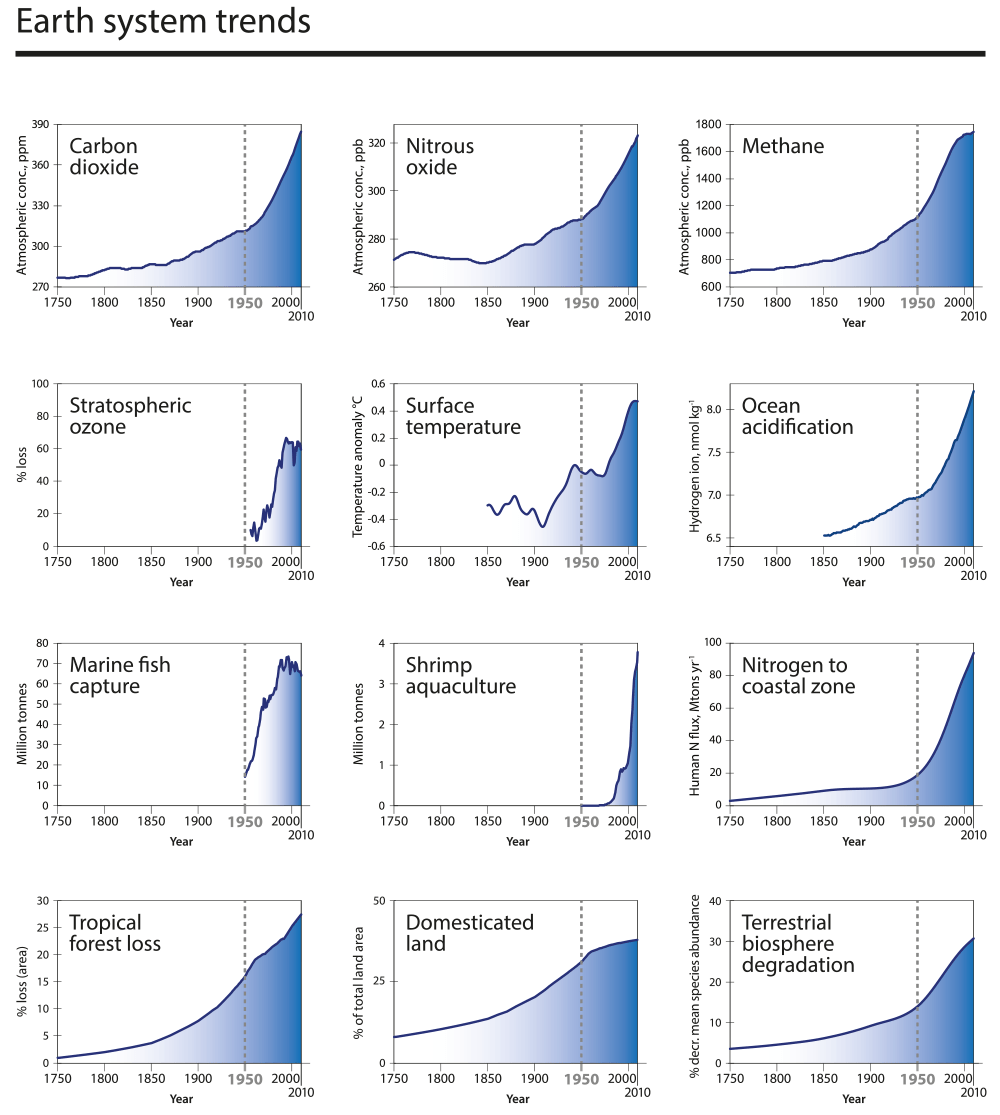
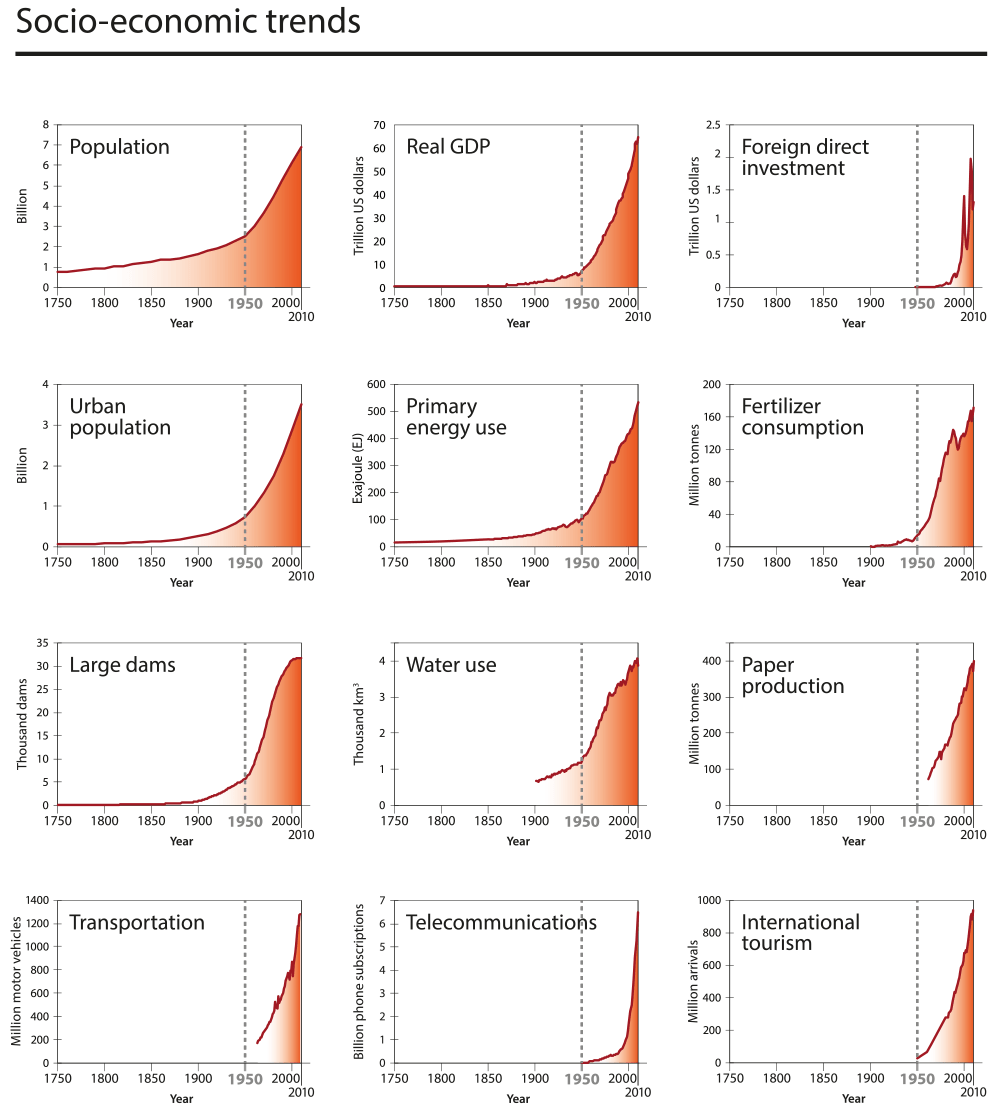
The Anthropocene, as these geologists imagined it, is distinguished by human interference with the great cycles that move energy and matter horizontally, across the Earth’s surface, and vertically, from the highest reaches of its atmosphere to its red-hot mantle, deep underground.
The carbon cycle, the water cycle, the nitrogen cycle, the phosphorous cycle, the rock cycle, the oxygen and water cycles: you can think of these as the engines of what’s called the Earth System. And they’ve all been fundamentally transformed by humanity.
Now, the International Commission on Stratigraphy, the authority responsible for defining and standardizing geological time units, just voted against recognizing a new Anthropocene epoch.
Still, it can’t be denied that the Earth’s puzzle pieces are being scrambled as they rarely have before, and that we’re to blame.
Take the carbon cycle. Imagine piling up everything built by humans. Every building, every road, every parking lot and bridge, every car, plane, ship – you name it. All of it added up would weigh about a trillion tons.
Now picture all the carbon dioxide released into the atmosphere since the industrial revolution that began at the end of the eighteenth century. That’s more than two centuries of burning coal and oil, of making cement (which releases carbon dioxide), and of hacking down forests that once absorbed carbon.
If you could weigh all of that carbon dioxide, you’d find that it’s heavier than everything we’ve made. Heavier than the entire built environment.
You’d also find that it’s probably heavier than every living thing put together. That includes billions and billions of mammals, trillions of trees, quintillions of worms, and more microorganisms than there are stars in the universe.
We can’t exactly put all of Earth’s life – what we call the biosphere – on a scale. But scientists currently estimate that the biosphere weighs about as much as every human-made thing. That means it’s likely outweighed by the carbon dioxide we’ve sent into the atmosphere.
So: one trillion tons of carbon dioxide in the atmosphere, thanks to us, and the number is growing by nearly 40 billion tons every year.
I find it hard to wrap my head around numbers that big. But here’s a way to think about it: it’s an annual increase that would weigh as much as 400,000 of the biggest aircraft carriers in the US Navy. It’s like we’re vaporizing all of those ships every year.
Bear in mind that there are only eleven aircraft carriers in the Navy.
Now, midway through the nineteenth century, carbon dioxide accounted for about 280 out of every million molecules in our atmosphere. In other words, carbon dioxide concentrations stood at 280 parts per million, or PPM.
It’s a really important acronym in climate research, because right now, in 2025, the concentration of carbon dioxide in our atmosphere has reached around 420 PPM.
Think about that for a second. In about 150 years, humanity has increased the amount of carbon dioxide in the atmosphere by one third.
Admittedly, the total weight of our planet’s atmosphere is around 5 quadrillion tons, so our carbon dioxide emissions have only added about 0.014% to the gas in the atmosphere.
But by adding 50% to the tiny fraction of the atmosphere that is carbon dioxide, we’ve profoundly changed how Earth works.
That’s because carbon dioxide is a greenhouse gas. You’ve probably heard that term before, but let’s take a minute to really break down why a greenhouse gas warms a planet.
Visible light from the Sun travels in short waves, or what scientists call wavelengths, that barely interact with the molecules in greenhouse gases. This light travels in short waves because it’s full of energy. It came from the scorching-hot Sun, after all.
Now, when sunlight strikes something in Earth’s atmosphere or on Earth’s surface, a lot of it bounces right off. Actually, a little under a third of the sunlight that strikes our planet is immediately reflected back into space.
The rest is absorbed and then re-emitted as a less energetic kind of radiation than visible light.
To understand why, imagine you’re lying on a beach beside a lake on a sunny summer day. Sunlight hits you. Some of it flies back into space. Your body absorbs the rest. It causes the molecules in your body to move a little faster.
That raises your temperature. Your warmer body now releases radiation of its own. Because your warm skin isn’t as hot as the Sun, I hope, the radiation carries less energy.
The name for this radiation is infrared.
Because infrared radiation has lower energy than the original, visible light, it travels in longer waves. You could see a similar process at work if you sat up on that beach and threw a rock into the lake.
The waves you’ve created are full of energy at first, so they’re narrow and packed together. But as they lose energy, they stretch out. It’s not a perfect analogy, but you get the picture.
Infrared radiation from your perfectly tanned skin may also travel out towards space. But the long waves of infrared radiation do interact with greenhouse gas molecules. To be more precise, they carry just the right amount of energy to make those molecules vibrate like a drum when they’re hit.
The vibrating greenhouse gas molecules absorb and re-emit some of the infrared radiation, in all directions, including back down to Earth’s surface. That’s key. Radiation that would have escaped into space now sticks around for a while longer.
So, energy builds up in Earth’s atmosphere. The energy makes other molecules, molecules of all kinds, in your skin, for example, move a little faster. The temperature of the Earth as a whole goes up. Changes in temperature, after all, are caused by changes in how fast particles move.
That’s why greenhouse gases warm the Earth. In very simple terms, they really do work like a greenhouse. The radiation we can see gets through. The radiation we can’t see gets stuck. This in essence is the “greenhouse effect.”
Carbon dioxide and other greenhouse gases are so good at trapping heat that they keep the Earth from freezing over, even though they account for only a tiny part of our atmosphere. Without them, the average temperature of the Earth would be more than 30 degrees Celsius colder than it is today.
This is why dumping a trillion tons of carbon dioxide into our atmosphere is a really big deal. It actually is like cranking up the planet’s thermostat.
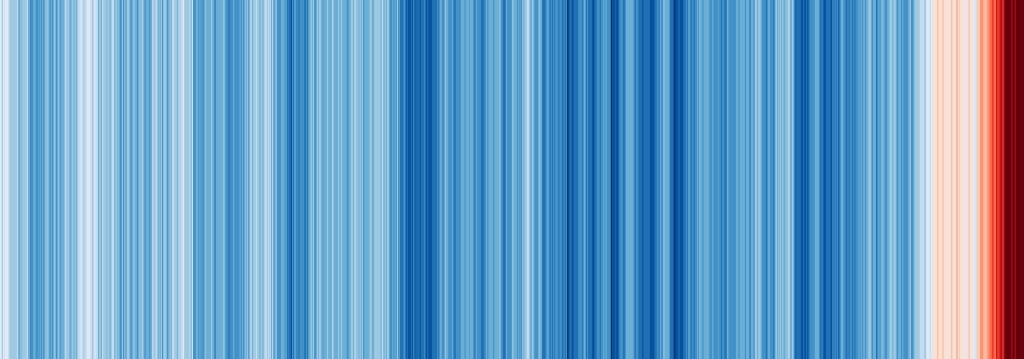
And indeed, our world’s average temperature has soared by about one and a half degrees Celsius as I write these words, relative to where it was in the late nineteenth century.
One and a half degrees Celsius may not seem like much. If you raise the thermostat in your home by the same value, you might not even notice.
But remember that climate change is about averages and variance. It turns out that a quick, one-and-a-half-degree Celsius boost in global average temperatures comes up with a monstrous increase in deadly heatwaves.
It also supercharges the water cycle, leading to more evaporation and heavier precipitation. Damaging droughts and floods are now much more common than they were. Of course, that’s only scratching the surface of what global warming is doing to our world.
I’ll give you the complete story in later episodes. What I want to emphasize now is that our carbon dioxide emissions have totally unbalanced the carbon cycle.
Normally, carbon dioxide enters the atmosphere through the respiration and decomposition of living things, or through volcanic eruptions and outgassing from the ocean.
It leaves the atmosphere when it’s absorbed by what scientists call sinks: plants and the oceans, or silicate and carbon rocks that trap some of the carbon dioxide that falls to Earth in rain.
From year to year, the amount of carbon dioxide that nature pushes into the atmosphere is about the same as the amount it pulls out of the atmosphere.
But now, every year, humans pollute the atmosphere with about twice as much carbon dioxide as natural sinks can absorb. That’s why carbon dioxide keeps adding up in the atmosphere.
So, it’s obvious that by transforming Earth’s atmosphere, we’ve thrown its carbon cycle entirely out of balance. And by upending the carbon cycle, we’ve disrupted an even more important balance, between the amount of radiation that reaches Earth from the Sun and the amount that escapes into space.
It may be the most dramatic manifestation of the Anthropocene.


Okay, so: how bad is it? How much trouble are we actually in?
What can nature’s archives tell us?
In The Climate Chronicles, we’ll answer those questions in many different ways.
For now, let’s begin by asking an obvious follow-up question that may sound a little strange at first. Put simply: can natural archives show us whether something like the Anthropocene has happened before?
Is our planet truly in uncharted territory? And if not, what happened the last time we were in this much trouble?
Now, in 2018, the climatologist Gavin Schmidt and the astrophysicist Adam Frank introduced what they called “The Silurian Hypothesis.” In the sci-fi show Dr. Who, the Silurians are an intelligent reptilian species that conquered the Earth millions of years ago, and developed technology more advanced than ours.
The idea that we humans are not the first intelligent creatures in Earth’s history has long intrigued sci fi authors. It was a central theme of H. P. Lovecraft’s work, for example. But Schmidt and Frank proposed an idea that, to my knowledge, was new.
If a truly ancient civilization had grown to resemble ours, they asked, would there be any sign of it left in the archives of nature?
Maybe not. Remember, the information in natural archives isn’t preserved forever. The Earth’s changes eventually wipe away many of its records. It’s a little like how you might throw away that embarrassing diary you wrote as a teenager.
Take your teeth. Their dentin layers are full of organic material, making them porous. Fluids, like groundwater, can easily enter these layers, washing away or altering their isotopes. Dentin in your teeth can therefore only record the climate in which you lived for a few thousand years.
Enamel layers are more durable. Because more of these layers are composed of crystal, their isotopes can preserve environmental information for millions of years.
So different natural archives and their proxies are more or less durable, but as a rule the most durable ones are usually least sensitive to changing environmental conditions. This means that the further back in time we go, the less we know about our planet.
That’s especially true for the living things on our planet.
Plants and animals have to be fossilized – to be turned into rock – to be preserved for a long time after they die. But only a tiny percentage of plants and animals are actually fossilized. If they’re bony, they have a better chance; if they live in the tropics, where things decay more quickly, their odds are slim.
Long-lived species stand a better chance of being fossilized. Scientists believe that the average species survives for about two and a half million years. Our species, Homo sapiens, has only been around for about 300,000 years. Yes, there are many of us, but it’s entirely possible that aliens visiting Earth will someday find no human remains at all.
That’s doubly true because we’ve congregated in cities, and cities cover only about one third of one percent of the world’s total surface area. Our buildings and roads, vehicles and tools won’t last very long, and most will be packed in a tiny part of the world.
So, if we go extinct tomorrow and aliens find our planet in a thousand years, they’ll have a lot to work with. Maybe they’ll even find your teeth. But if they show up in a few million years, they may never guess that we were here.
At least, not at first. Maybe they’ll take some pictures of the Moon and find the wreckage of our spacecraft. Since the Moon’s surface barely changes, our machines should still be there.
Now our alien visitors could decide to look for indirect evidence for an industrial civilization on Earth. They might investigate whether that civilization started to tamper with the life-giving cycles of its planet. If so, they’d consult natural archives.
That’s exactly what Schmidt and Frank proposed for today’s human scientists. Sediments on the ocean floor, they pointed out, would preserve the isotopic residue of an industrial civilization that had transformed the world’s environment.
Take climate change. The sediments that compose the ocean floor are archives of nature partly because they’re full of microscopic shells. Tiny organisms made these shells by using chemicals in ocean water.
Lighter oxygen isotopes with fewer neutrons evaporate more easily from the oceans than heavy isotopes. They fall as rain or snow and usually find their way back to the ocean.
But when the Earth is really cold, giant glaciers start to cover much of its surface. The light oxygen isotopes that fall in snow can be trapped in those glaciers. Because the isotopes don’t work their way back to the oceans, there are now fewer and fewer light isotopes in the oceans.
The ratio of heavy to light oxygen isotopes therefore increases in ocean water. It also builds up in the shells of organisms that are made out of ocean chemicals.
When these organisms die, their shells fall to the ocean floor. Slowly, more and more of them accumulate in sediment. Their isotopes record a time when the Earth was cold.
Then, after thousands of years, the Earth warms. The ice sheets melt, and release their isotopes back into the oceans. New shells are formed, then drop down to the ocean floor. Now their isotopes tell a tale of a hotter planet.
Are the data provided by ocean, or marine, sediments super precise? No. But they record Earth’s temperature for about 170 million years. That’s a lot longer than the dentine in your teeth.

Now imagine that a species – we’ll call them the Silurians – emerged, let’s say, tens of millions of years ago. They industrialized like we have, and started burning up coal, then oil and gas.
In our scenario, it didn’t take long for the climate to warm, and warm, and warm. Temperatures rose abruptly, by something like five to eight degrees Celsius. One species after another went extinct or migrated towards the poles.
The Silurians held out for as long as they could. Then, at last, they disappeared, and the climate began to cool down. Slowly, over many thousands and millions of years, the Earth healed itself.
It’s a worst-case scenario for our future. And it’s a catastrophe that, if it happened before, would probably be visible in marine sediments.
So, here’s the thing. The Earth did warm, abruptly, 56 million years ago. We call it the Paleocene-Eocene Thermal Maximum. It separated one geological epoch, the Paleocene, from another, the Eocene. Many species went extinct, including half of the microscopic shell-forming species in ocean sediments.
What’s more, these sediments reveal the cause of the abrupt warming: a sudden release of greenhouse gases into the atmosphere. And not just any greenhouse gases. These were gases that were rich in light carbon isotopes.
That’s right: more isotopes! But this is really wild. Let me break it down for you.
Now, like oxygen, carbon comes in heavier isotopes, with more neutrons, and lighter isotopes, with fewer neutrons. Plants, which need carbon dioxide, prefer the lighter carbon isotopes. More light than heavy carbon isotopes enter plants and the bodies of the animals that eat those plants. When plants and animals die and decay, some of them turn into fossil fuels, such as coal or oil.
Ocean creatures make their shells not only with oxygen, but also with carbon. The carbon can enter the oceans from the atmosphere. Microscopic shells in ocean sediments tell us that there was an explosion of light carbon isotopes in the atmosphere during the Paleocene-Eocene Thermal Maximum.
This explosion had many potential sources. Volcanic eruptions, for example, could be responsible. That’s because microbes also prefer the light carbon isotope, and they sink into Earth’s crust. Earth’s scorching hot mantle therefore has more light than heavy carbon isotopes. Volcanoes can increase the number of light carbon isotopes in the atmosphere.
But… the widespread burning of fossil fuels would also cause the same surge of light carbon isotopes. And it would certainly cause the sudden warming that occurred 56 million years ago.
Just how much carbon poured into the atmosphere during the Paleocene-Eocene Thermal Maximum?
Well, somewhere between 5 and 10 trillion tons.
Five trillion tons of carbon translates into just over 18 trillion tons of carbon dioxide. That’s because every carbon dioxide molecule has one carbon atom and two oxygen atoms.
It is conceivable that, in the next few centuries, humanity will end up polluting the atmosphere with nearly that much carbon dioxide.
If so, our alien researchers of the future will find traces in ocean sediments of something very similar to the Paleocene-Eocene Thermal Maximum.
They might not be able to prove that we were responsible for it.
But they might wonder: was it possible for one planet to give rise to two civilizations that were stupid enough to tamper with its climate?
Shouldn’t the second civilization have learned from the first one?
It’s an interesting thought experiment. And no, I don’t actually think that something like the Silurians conquered our planet in the distant past.
The Paleocene-Eocene Thermal Maximum was probably caused by a massive wave of volcanic eruptions, a wave associated with the expansion of the Atlantic Ocean.
Although scientists debate how quickly it happened, it’s likely that carbon dioxide accumulated in the atmosphere over many centuries: far longer than we’re likely to pollute our atmosphere.
This was really just a fun way to introduce you to natural archives, and the deep history of climate change.

And yet. At sunrise or sunset, you might see a brilliant star above the horizon. It might be so bright that it doesn’t look real at first. You might even think it’s a plane.
That’s Venus, a planet almost exactly the same size as Earth. Some scientists believe that Venus once had oceans. If so, it may be that life evolved there. Maybe even intelligent life.
Today, the surface of Venus is a hellscape. At almost 500 degrees Celsius, it’s not as hot as an oven – it’s hot enough to melt the oven. Its toxic, carbon dioxide atmosphere is now a sickly, milky white, which is one reason it’s so bright in the morning or evening sky.
It turns out that if we commit ourselves to burning every fossil fuel on Earth, to digging up every last lump of coal and every last drop of oil, we could probably set in motion a runaway greenhouse effect that would eventually turn our planet into a second Venus.
It would take centuries, but it can be done. And I’m sure a lot of people would make a lot of money in the process – until the world burns around them.
So maybe, when those aliens visit our solar system, they’ll find two equally inhospitable sister worlds.
They’ll move on.
But they might wonder at the coincidence.
For Teachers and Students
Review Questions:
- What are the archives of nature? What are proxy sources?
- How do geologists organize Earth’s history?
- What is the Anthropocene?
- What was the Paleocene-Eocene Thermal Maximum, and what might have caused it?
Key Publications:
Grinspoon, David Harry. Venus Revealed: A New Look Below the Clouds of our Mysterious Twin Planet. Cambridge: Perseus Publishing, 1997.
Schmidt, Gavin A., and Adam Frank. “The Silurian hypothesis: would it be possible to detect an industrial civilization in the geological record?.” International Journal of Astrobiology 18:2 (2019): 142-150.
Thomas, Julia Adeney, Mark Williams, and Jan Zalasiewicz, The Anthropocene: A Multidisciplinary Approach. John Wiley & Sons, 2020.
Video and Audio Credits:
Audio: AIVA, Runway.
Video: Runway, Sora.
Funding provided by Georgetown University’s Earth Commons.
Leave a Reply